Zambia
Heart of the HunterZambia is the destination that gives Thobela Mpayipheli’s escape its direction and its personal purpose: he intends to reach Lusaka, where an old friend is waiting. Though the country appears chiefly as a point on a map rather than as a setting for an extended scene, the journey toward it turns a family conversation into a dangerous cross-border undertaking.
A country made legible on the map
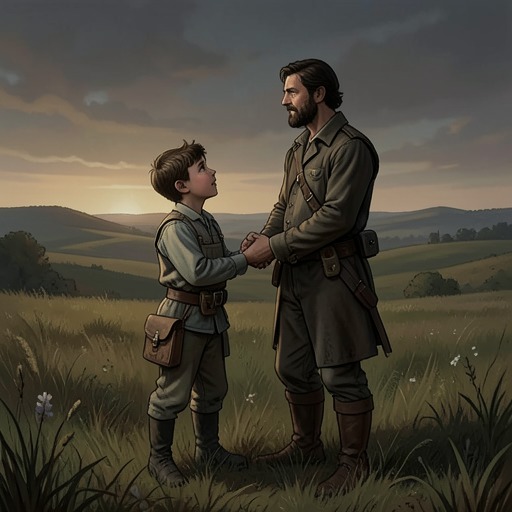
Mpayipheli introduces Zambia to Pakamile Nzululwazi by opening an atlas to a map of Southern Africa. When Pakamile guesses that it might be in Mpumalanga, Mpayipheli points out Cape Town first, then indicates Zambia farther north. The lesson is practical as well as geographical: his departure must remain secret, and the child needs to understand where he is going without revealing the plan to others.
He describes a proposed air route in simple stages. He will fly from Cape Town to Johannesburg, then take another plane toward Lusaka, travelling over Zimbabwe or perhaps Botswana. Lusaka, he explains, is a city like Cape Town, and the reason for the journey is an old friend. Pakamile’s question about cake and cold drinks briefly brings the distant destination back into the scale of a child’s everyday expectations; Mpayipheli can only say that he hopes there will be some.
From an imagined flight to a road journey
The air route is not the route the narrative follows once Mpayipheli escapes Cape Town. He takes a BMW R 1150 GS, a machine whose power and size initially unsettle him. As he turns onto Oswald Pirow Street, the bike’s acceleration nearly catches him out; he struggles to control its weight, brakes sharply, and reaches the N1 cautiously. Even as the unfamiliar motorcycle carries him away, its speed and handling make clear that escape depends on learning to manage the means of travel as he goes.
The distances ahead become part of his calculations. Beyond Touws River, he considers refuelling at Laingsburg, then facing roughly 200 kilometres to Beaufort West across the Great Karoo. From there, Bloemfontein lies another 500 or 550 kilometres away. He weighs whether he can reach it before sunrise and considers resting in a township during the day. Zambia remains the far-off objective, but progress toward it is measured in fuel stops, hours of darkness, and stretches of road that cannot safely be hurried.
Borders, pursuit, and the limits of movement
The journey north is not simply a matter of covering distance. While hiding beneath a bridge, Mpayipheli recognizes that the hours lost there matter because he still has at least two national borders to cross. He carries his passport but lacks papers for the motorcycle. Bribing customs officers might work, but haggling would cost time and could fail; slipping through a gap in a border fence seems a possible alternative. The Zambezi River, however, is a more formidable obstacle than a fence, and he knows the hiding place will offer no protection after daylight arrives.
Pursuit further complicates his movement. Near the Three Sisters, two helicopters follow low behind him as he rides at more than 200 kilometres per hour toward a bank of heavy rain. He hopes the weather will hinder them; when the storm closes around the motorcycle, visibility becomes dangerous, but the helicopters’ sound eventually fades. This escape is a temporary advantage rather than proof that the route is clear. The passage makes the journey toward Zambia a contest between a fugitive’s improvised choices and forces able to watch and outpace him.
The destination and its personal stakes
Zambia is not presented as an abstract terminus. Mpayipheli’s stated reason for going to Lusaka is his old friend, and his sense of obligation is bound to that relationship: he insists to Miriam Nzululwazi that he owes Johnny Kleintjes a debt of honour. He acknowledges that refusing is a choice, but believes that keeping faith with Johnny is part of doing what he considers right, even though he had meant to leave violence behind.
That choice sets the journey toward Zambia against the quieter future Mpayipheli has imagined with Miriam and Pakamile at the Cala River. In his thoughts, a new beginning away from crime and hardship remains possible, but the obligation to Johnny pulls him back onto the road. Zambia therefore functions both as a real geographical destination, approached through routes, borders, and the Zambezi, and as the far end of a moral commitment whose cost is still unfolding.